Our education system teaches us that the proper route is the one with the most hoops. Then when the hoops don’t fit our brains, we blame ourselves for not trying hard enough.
This pattern doesn’t stop at school - it runs right through professional credentialing and assessments all the way through adulthood. It’s why people spend years collecting certificates, before they feel ‘allowed’ to do what they know.
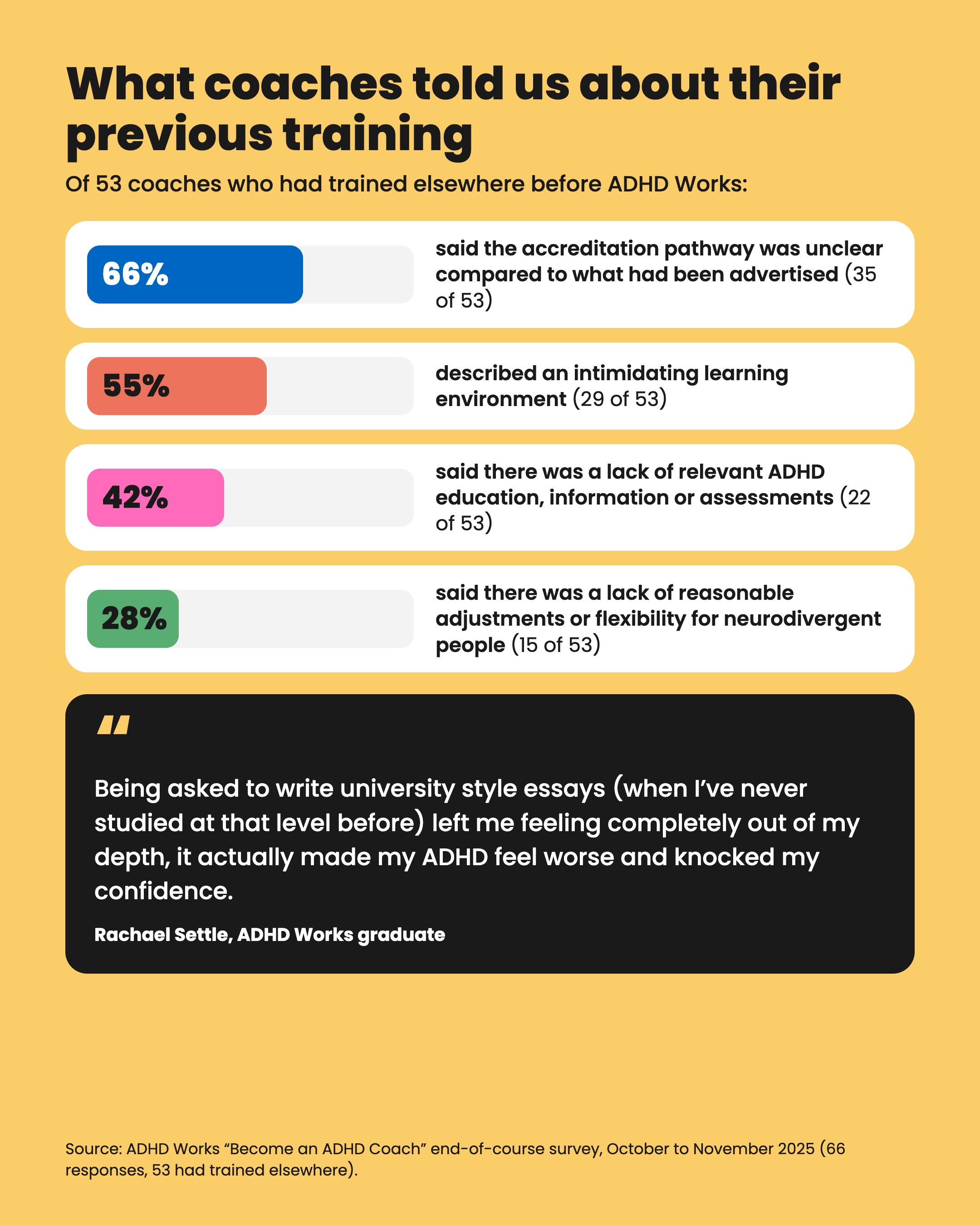
At ADHD Works, we believe that one size doesn’t fit all, whether that’s for teachers, students, coaches, or clients alike.
While we strongly and explicitly support the ethics of bodies such as the International Coaching Federation, including within our training and own Ethical Compliance Framework, there are a few reasons why our courses are not accredited by them, including:
Neurodivergent people don’t always know what they need help with - they just know that they need help
Our coaching approach is based on using ADHD & AuDHD Specific Frameworks as an ‘optional menu’. This includes a series of psychoeducation and practical exercises, enabling people to understand what their neurodivergence means for them.
This gives structure and containment to coaching sessions and programmes overall, working as a touchstone for coaches and clients alike to keep sessions focused.
Traditional coaching approaches, such as the ICF, require the client to bring the agenda - not the coach. This might look like expecting the client to communicate:
what they want to focus on that session (neurodivergent people may not know, change their minds, or mask)
what they want to get out of that conversation (which may not be clear if the context of what is even possible to get out of that conversation isn’t already known)
how they would know if they had achieved this objective (which may be very difficult for a non-linear brain to identify, and can act as an expectation to meet, potentially resulting in Rejection Sensitive Dysphoria).
Coaches are also not supposed to share their own experiences, or provide advice. Whilst there is a balance and nuance to this skill, we do know that for many neurodivergent people, it’s an extremely important element of being able to trust the coach to collaborate with you, rather than recreating a power hierarchy that may feel inauthentic.
Asking a coach for advice and being shut down, for example, can result in significant feelings of RSD.
2. 80% of the training has to be about ICF’s Core Competencies - leaving 20% for everything else
Such approaches tend to be embedded within the ICF’s Core Competencies, of which 80% of training content within an accredited course must be mapped to.
This would leave only 20% of our training hours available to teach anything outside of these ICF competencies - including business, pricing and finding clients. Most of all, we think that an ADHD or AuDHD coaching course shouldn’t just focus on competencies - but actually the brains it’s built for - and the environments we’re trying to navigate.
This includes the wider context of neurodivergence, much of which will fall outside of the scope of coaching, but will certainly come up anyway:
safeguarding and signposting, especially within the context of working with vulnerable people and navigating disability, mental health, and clinical support (or lack of it!)
disability discrimination law and reasonable adjustments at work or within education, without getting involved!
diagnosis and assessment pathways, assessment and medication waiting lists, medication shortages, and societal stigma
co-occurring conditions such as autism and ADHD, how these interlink, and how this may arise within coaching
conflicts and misunderstandings with employers, family, schools or partners, and boundaries around our role as a coach
the coach’s own potential neurodivergence, including ensuring appropriate support systems are in place to avoid burnout
This information isn’t an optional extra squeezed into the last 20%. It’s the whole point - and if you don’t learn about how to handle the areas that are out of scope, you’ll be learning on the job - and that is where harm happens, because we’re not expecting it.
3. Live attendance doesn’t necessarily equate to the best learning style for neurodivergent brains
ICF training requires 60+ contact hours, with at least 50% being live (‘synchronous’).
The thinking behind it makes sense: live learning means interaction, practice and feedback. But it also assumes that being in the room at a set time is when learning happens. For a lot of neurodivergent brains, that just isn’t true.
Measuring learning by attendance is a school habit. It tracks who was present, not who understood - and expects students to learn in the same way.
The fundamental principle underneath our approach is that we trust our students to do the work in the ways that work for them. Live sessions are recorded and uploaded, and students have lifetime access to the lessons, rather than having to remember what was taught to them at one point in time.
4. An ICF-accredited course does not automatically mean ICF-accredited graduates
If ADHD Works were to obtain ICF accreditation, our courses would be credentialed - but our graduates would have a long way to go.
To even apply for the entry-level ACC credential as a coach, after graduation, an individual would have to:
Log 100 hours of coaching with at least 8 clients, with at least 75 of these hours being paid.
Complete 10 hours of mentor coaching over at least 3 months (usually paid for by the coach, which is specifically focused on meeting ICF competencies as opposed to supervision)
Only when these requirements are met, they could then apply:
Submit a recorded coaching session to be scored
Pass a 60-question, 90-minute multiple-choice exam
Pay the application fee (around US$175 for ICF members or US$325 for non-members), plus around US$270 a year for membership
They also have to renew this ACC credential every 3 years, requiring the coach to:
Complete 40 Continuing Coach Education credits. At least 24 have to be in ICF’s Core Competencies, including 3 on coaching ethics, and the other 16 can be Core Competencies or Resource Development.
Complete (and presumably pay for) another 10 hours of mentor coaching.
Pay the renewal fee: $175 USD for ICF members, $275 USD for non-members. Renewing late adds a one-time $100 USD late fee.
As many people pursue ICF credentials with the hope of securing paying clients, it seems contradictory to require that graduates have 75 paid coaching hours before they can even apply.
This is also quite difficult to communicate clearly to people in a way that they fully understand that the financial and administrative requirements of them do not end with training - they will continue throughout their career.
This feels counterintuitive to the actual work itself, which is helping people - so it’s best if you’re not stressed out about checking boxes to be able to do your best work!
5. Checkboxes don’t necessarily equate to quality or ethics
Credentialing systems are good at counting things: hours logged, sessions observed, exams passed, fees paid. What they can’t easily show is whether clients were actually safe and well supported - the qualitative experiences that often happen within situations where there is an imbalance of power.
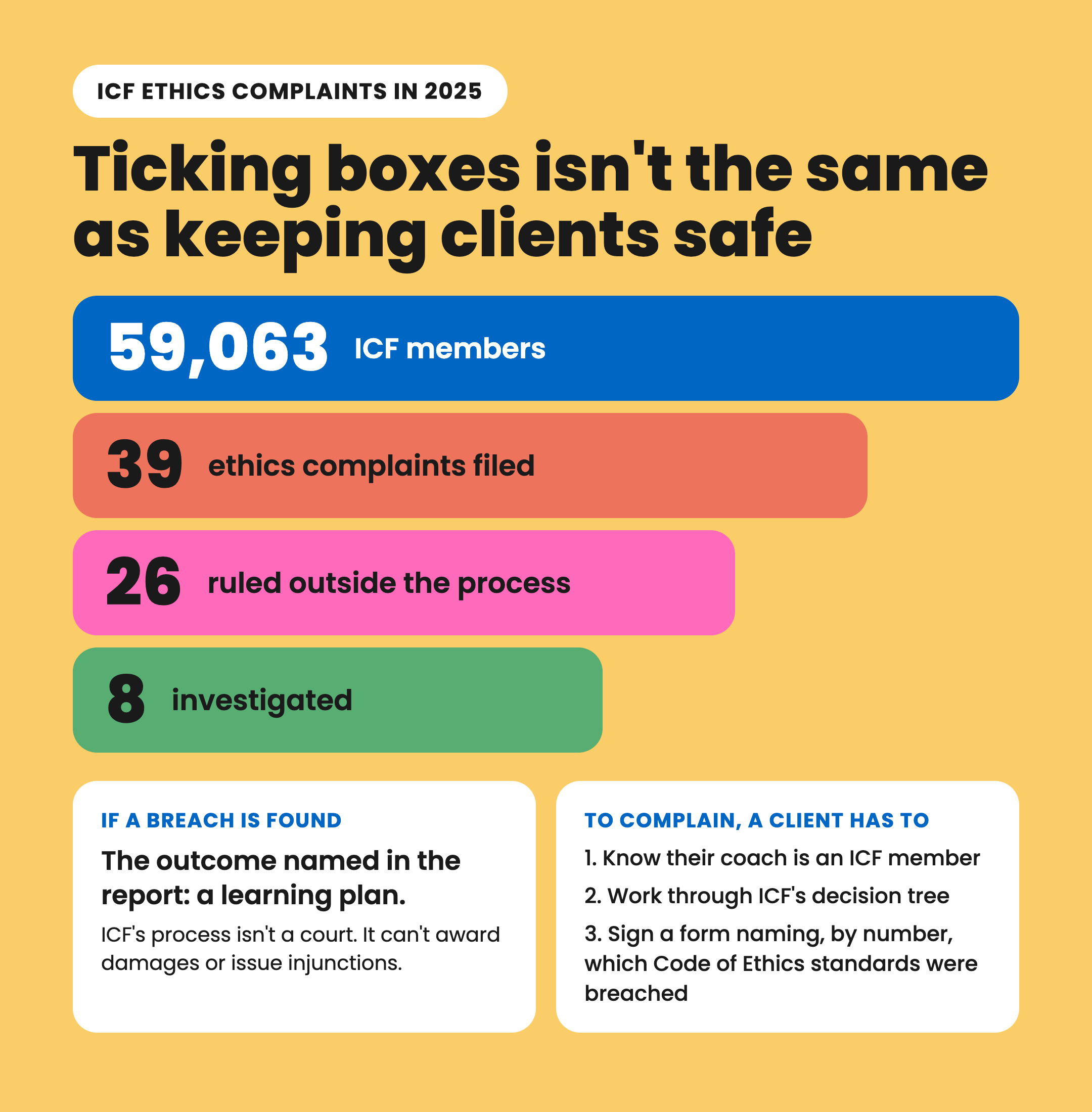
Each year, the ICF publishes an Ethical Conduct and Compliance Report. In 2025, it had over 59,000 members. Across all of them, 39 ethics complaints were filed and 8 were investigated. Where a breach was found, the outcome was a learning plan. ICF is clear that its ethics process isn’t a court, so it can’t award damages or stop anyone practising.
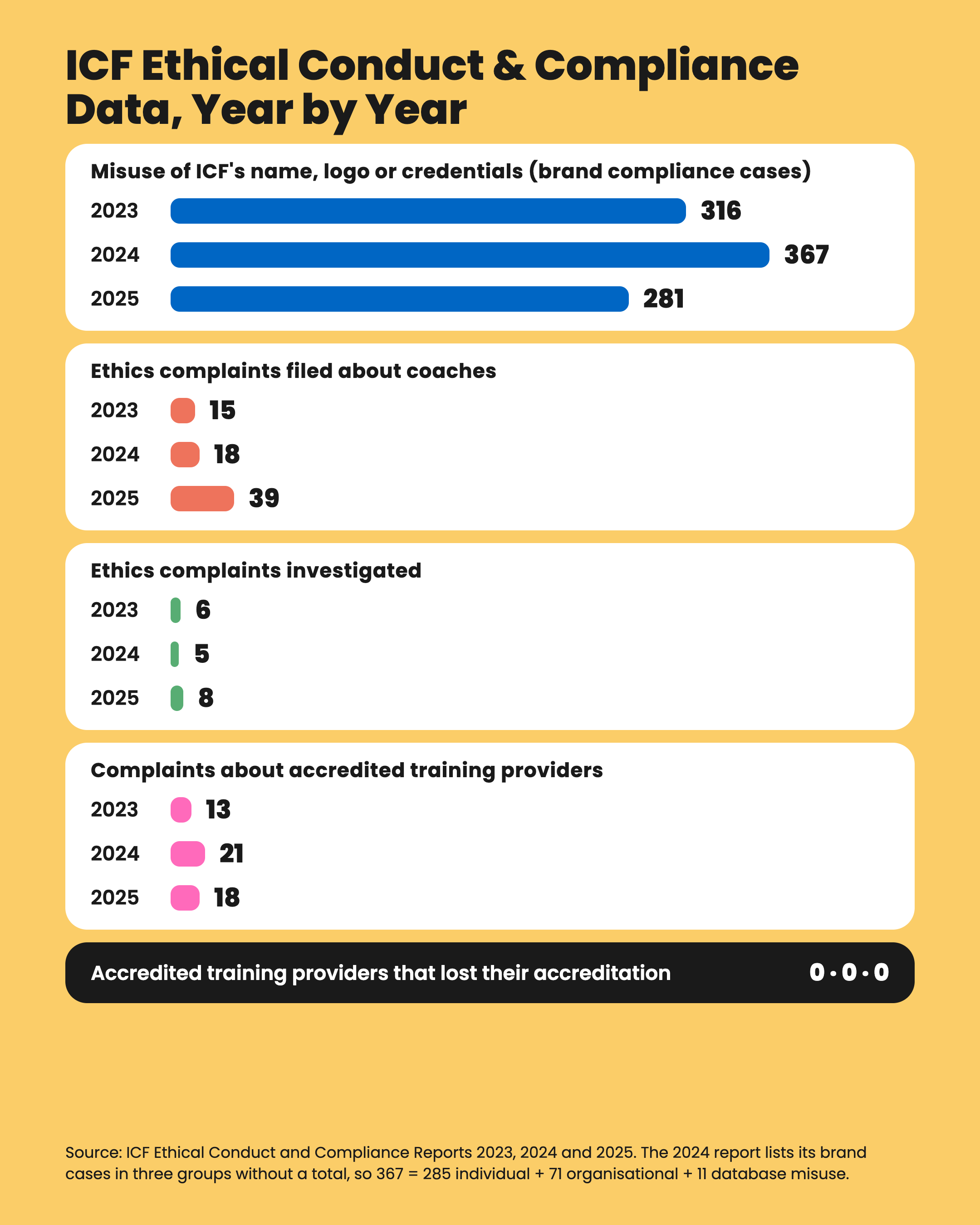
Complaints about ICF-accredited training providers are counted separately. There were 18 in 2025, mostly about unclear expectations and questionable business practices, and no provider lost its accreditation.
Meanwhile, ICF handled 281 cases of people or organisations using its name, logo or credentials without permission - around seven brand cases for every ethics complaint.
None of this means ICF is acting in bad faith. Protecting a trademark is normal for any organisation, and a low number of complaints could genuinely mean most coaches are doing good work.
But it does raise the question of what, and who, the credential is actully for. It tells clients someone completed the hours, paid the fees and passed the exam. It doesn’t tell them whether that coach understands their brain, notices when they’re overwhelmed, or knows when to refer them on.
Neuro-affirmative Learning
Even the most well-intentioned organisations struggle to be genuinely neuroaffirmative when the requirements they have to meet were designed for neurotypical people.
In practice, that looks like:
Fixed hours and formats, when many of us learn in bursts, loops and deep dives
Timed, high-stakes exams as the gatekeeper, testing memory and exam technique as much as coaching skill
Paid-hours thresholds that shut out people who are just starting out, often the people we most need in this work
A neurotypical framework: competencies designed around how neurotypical brains think and communicate, which can treat what neurodivergent clients need, such as structure and guidance, as stepping outside ‘pure’ coaching
Cost and admin that inevitably get passed on to learners
Perfection doesn’t exist - and the way we work definitely won’t work for everybody - but we do try our best to use a training and learning structure that is adaptable for the individual, not how we think they ‘should’ be learning.
The downside of this is that it falls outside of a neurotypical education system of how things ‘should’ look, which is understandably uncomfortable to the status quo. But it works for us, our students, and our clients - so it’s what we do.