How to solve the global ADHD crisis
Along with awareness, ADHD diagnoses have risen sharply around the world since 2020 - and so has public outrage. This isn’t so much about the 10 year waiting lists, but the millions of people daring to seek or offer help.
Last year, the NHS England ADHD Taskforce reported that ADHD was under-diagnosed, costing the UK £17 billion per year. Its suggestion was the obvious one: make access to support easier.
This is what I recommended to Directors of the World Health Organization 4 years ago. Where public systems leave a gap, the market fills it, at the expense of vulnerable people who are already struggling.
This week, a new UK Government review, led by Professor Peter Fonagy, is expected to recommend limiting formal diagnosis to only those who ‘need it’, and offering support to everybody else, triaged according to need.
If the bar for accessing help is raised, it will simply push more people into crisis - as has already been seen by similar initiatives in the UK, which unsurprisingly, did not work.
"The intended move to a needs-based model had not reduced the demand for diagnostic services."
- Scottish Parliament research briefing (SPICe, June 2025)
What does an ADHD diagnosis actually do?
In practical terms, not much. This is in contrast to myths that it can ‘unlock’:
Government benefits and disability funding: much of which is already available without a formal diagnosis in the UK, such as Access to Work or PIP.
Legal protection and/or adjustments at work: which does not require a formal diagnosis (despite commonly being misunderstood by employers, as in this recent case)
Formal access to support in schools: which is based on students needs, not diagnosis (although this is not always followed in practice).
EHCPs, which legally guarantee specific support for a child's special educational needs: these don't require a formal diagnosis either, yet local authorities frequently get this wrong. Around 99% of SEND tribunal appeals that reach a decision are found in families' favour.
‘Controlled’ ADHD medication: a diagnosis is needed, but not just any diagnosis. Many people pay for 'cheaper' assessments, only to find they were done by someone who cannot prescribe medication, such as a psychologist, or whose diagnosis a prescriber won't accept.
To access medication, they'd typically have to pay all over again with a suitable practitioner, usually a psychiatrist.
Even with a ‘valid’ diagnosis, they could still face refusals of shared care from their GP, global ADHD medication shortages, or it could simply not work for them, as happens with 30% of people.
There is no magic pot of money or waterfall of benefits waiting at the end of the wildly expensive ADHD assessment rainbow.
All of this support is literally available without a diagnosis - so why do people pay thousands or wait for years to get one?
Diagnosis isn't a barrier to help - for most people, it is the help.
A diagnosis is not a sentence, but it is validation: a formal acknowledgement that it is not your fault. It’s ultimately understanding - which should cost nothing to give.
What does it matter to approve the labels that people identify with, who ultimately know themselves better than a stranger who can’t read their mind? If a label helps them, then why not give it to them?
Well, as seen above, theory doesn’t always translate to reality.
Repeated failures by organisations to understand and follow the law can and does result in situations like:
The parent who’s told they need a formal diagnosis for their child to stop being punished for behaviour they cannot control, like ‘nervously laughing’.
The employee who’s told they have to provide a formal diagnosis to wear noise-cancelling headphones in the office, or turn their camera off during video meetings to be able to focus.
The parent who’s told they need a formal diagnosis for their child to be assessed for an EHCP, while their child can't face school and the only alternative is giving up work to home-school.
The child who's told they need a formal diagnosis to use a fidget toy, while they get detention for tapping their pen.
The employee who's fired by a manager who thinks that without a diagnosis, she isn't protected.
A right you don't know about, or can't use, isn't much of a right at all. Enforcing it takes time, money and energy: legal fees, paperwork, and months of stress. Most people don't have those to spare, least of all when they're already struggling - and organisations know this.
In the UK, the wait for an ADHD diagnosis can be years. In the meantime, your own account of your struggles counts for very little, despite the law saying otherwise. Without a piece of institutionally rubber-stamped paper, it's much harder to even ask for adjustments, or to challenge an organisation that refuses them.
Even with a formal diagnosis, there's no guarantee organisations will follow the law. The goalposts may simply move, leaving people devastated after spending so much time and money on the thing they thought would finally get them taken seriously.
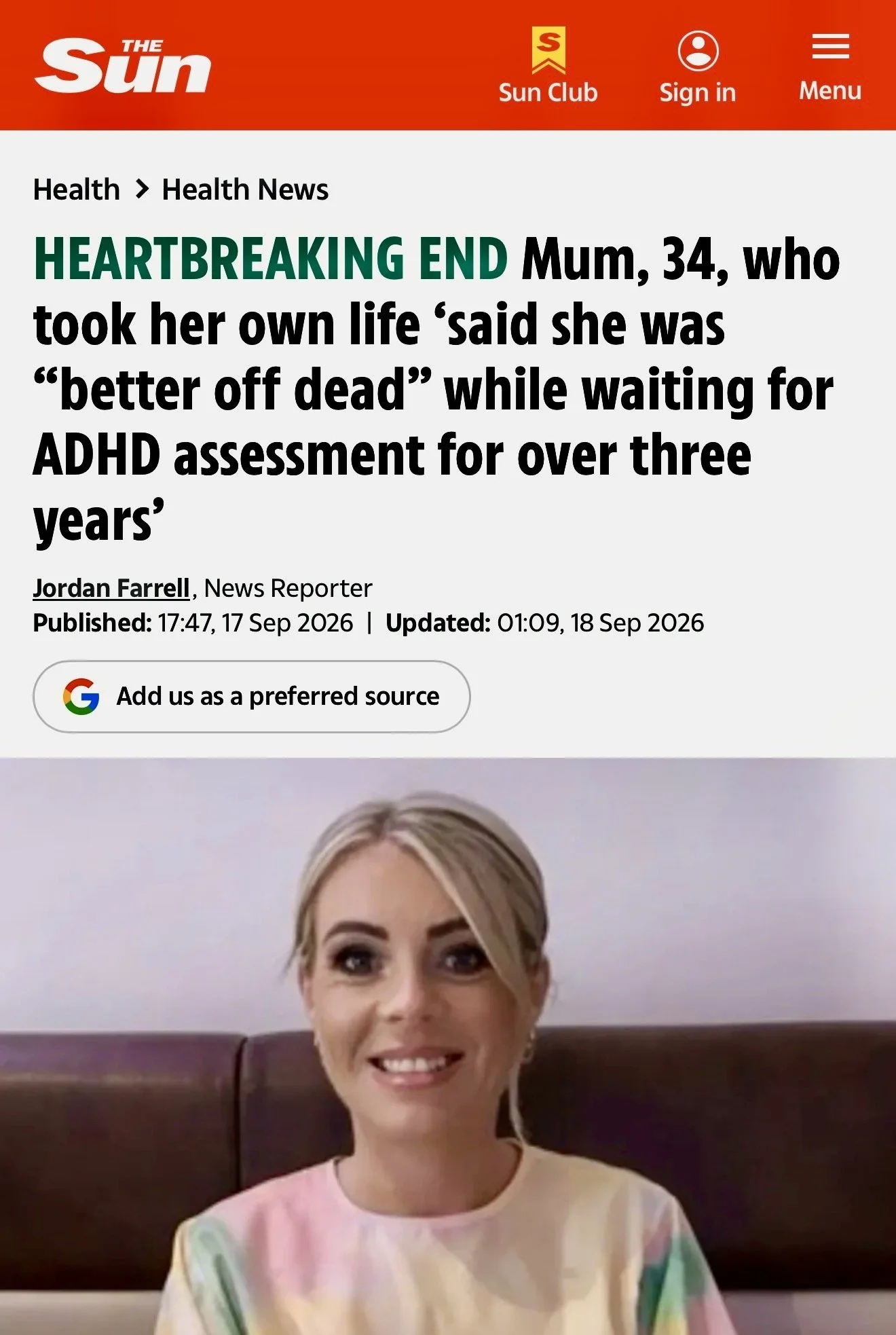
Meanwhile, people who are already suffering are left to suffer until they can't take it any more, just like Bethany Hewitt.
So the people who most need protection are left waiting for permission to claim it - and that is the real problem that Governments are trying to solve when it comes to who can access a label. Because if too many people are ‘certified’ as deserving of support, then the broken systems which fail everybody can no longer work.
The only answer is to make ADHD assessments easier to access.
After all, why can a GP prescribe highly addictive medication like opioids (contributing to over 100,000 deaths a year) without permission, but not tell someone that they have ADHD?
Why can't they simply offer support, compassion, understanding and empathy to their patients? What does it cost them to believe them?
A diagnosis is not, and should not be, the same as immediate access to medication. ADHD, like autism, is a neurodevelopmental condition, not an illness to be cured.
It's part of who a person is, and if their environment doesn't fit how their brain works, that's often what needs to change first. Medication can be a life-changing option for some, but it should be a separate decision, made once someone understands what they want to change.
If someone needs an ADHD diagnosis to be able to make those changes, then give them one. It is not giving them an excuse - it’s giving them permission to believe themselves, and to take personal responsibility, instead of wondering if they’re just ‘making it all up’ or not trying hard enough.
Can GPs diagnose ADHD? Lessons from Australia and New Zealand
Following Australia's Senate inquiry on ADHD in 2023, states are widening who can diagnose ADHD and prescribe ADHD medication to include GPs.
It's progress, but on its own it won't solve the ADHD crisis, because:
There's no national plan. The Senate inquiry recommended a national ADHD framework. The federal government took more than a year to respond, gave it only "in principle" support, and fully adopted just one of the 15 recommendations. So every state is going it alone, with different rules and training requirements, and where you live still decides what care you get. Until February 2026, Tasmanian pharmacists couldn't even dispense ADHD medication prescribed by a doctor in another state.
Funding hasn't changed. Medicare doesn't cover the time a proper ADHD assessment takes, so NSW is paying GPs up to $600 per patient for 2,500 free assessments. Once those run out, it's unclear who pays. Without proper funding, GPs risk becoming the new psychiatrists, charging private fees, or being pushed into 15-minute assessments.
The bottleneck just moves. It shifts to primary care, where GPs are already stretched and time-poor. Australia is already short of more than 3,000 full-time GPs, and the RACGP warns this could grow to over 17,000 by 2040. Around a quarter of people who see a GP in major cities already feel they wait longer than is acceptable, rising to a third in regional and remote areas, exactly where ADHD specialists are hardest to find.
Training is rationed too. In WA, over 400 GPs applied for just 65 funded training places. In NSW, just over 300 of roughly 9,500 GPs had started the diagnosis training by mid-2026. Victoria and South Australia have funded training for 150 and 100 GPs respectively, while Queensland requires no extra training at all. The gate hasn't gone. It has just got slightly wider.
GPs may be nervous to practise. However good the training, the risks of getting it wrong are real, as seen by medical indemnity insurers MIPS and MDA National issuing warnings to GPs about the legal risks of ADHD prescribing, from breaching state-specific rules to prescriptions that aren't valid across borders.
Success is measured in scripts. NSW's progress updates report how many GPs can prescribe, how many people are on medication, and how many prescriptions have been filled: over 70,000 so far. Even that data shows the gaps. GP prescribing in Western and South Western Sydney is less than half the rate of Northern Sydney. But there's no data on waiting times, on whether people are doing better at school, work or home, or on any support beyond the pharmacy. What gets measured is what gets done.
New Zealand shows where this can lead. Since February 2026, any GP there can diagnose ADHD, but only 15 to 20% are doing so, held back by workforce shortages and a lack of funding. Changing who is allowed to diagnose doesn't help much if they don't have the time, money or confidence to do it. It just results in wasted training, frustrated doctors, and patients told there's a new door, only to find it's barely open.
And most importantly, a diagnosis alone isn't enough.
Clinical guidelines say medication should be just one part of a holistic treatment plan for ADHD, but this is rarely what happens in practice. It's common to hear of people being ‘diagnosed and dumped’: handed a label, maybe a stimulant prescription, and then left to it.
This is likely what will happen in Australia on a mass scale as the reforms progress, along with a huge strain on primary care and widespread public confusion. Most people will not know:
Whether their GP is trained to diagnose ADHD and/or prescribe ADHD medication
What their GP can do within a 15 minute appointment, and how much they should be charging
Which medication or dose is right for them, how to tell if it's working, and what ‘good’ looks like
Why the rules change when they cross a state border
Whether the GP’s diagnosis will be accepted by their school, employer or another state
Whether they should also pay for a private assessment
How to talk to the people in their life about this
Whether they might also be autistic, given how often ADHD and autism occur together, and how autistic traits can become more noticeable after starting ADHD medication
What support is available beyond medication, like coaching, psychology or occupational therapy, and what Medicare covers
Whether their diagnosis affects their driver's licence, or whether they need to tell their employer
Before the reforms, people had no choice but to pay for a specialist, often over $1,000, even with a Medicare rebate. Despite being out of reach for those who couldn't afford it, waits could still stretch to two years. Compare that with the UK, where free NHS assessments come with waiting lists of many years.
Now imagine what happens when Australians believe they can simply book an ADHD assessment with their GP. This is what's been missed from the reforms: the people at the centre of them.
How to solve it
Being the person I am, I completed some of the GP training pathways myself. The training, delivered by a psychiatrist, understandably covered what ADHD is and the types of medication. But it didn't teach what's really needed: how to assess and support someone in a GP consultation, when you’re already stretched for time.
Following meetings with NSW Health's ADHD reforms team, I developed a set of free resources for GPs to use and share with patients. I've since shared them with health departments in every Australian state and territory, calling for a national approach to patient education.
This has led to further meetings with the ACT's Chief Psychiatrist and Chief GP, and with the WA Health Minister's Principal Policy Adviser at the Minister's request, as well as an invitation to meet Victoria's Health Minister, and responses from six of Australia's eight states and territories.
I’ve also spoken with GPs who have undertaken the ADHD diagnostic training, specialist psychologists, teachers, parents, and people diagnosed with ADHD themselves.
Every conversation has confirmed the same thing: the people, the goodwill and much of the support already exist. What's missing is someone joining it all up, which is why resources alone won’t fix it.
For governments, health services, schools and employers, connecting the dots to fix the system looks like:
Get clear on what a diagnosis means, and educate people about it upfront. Point them towards resources that should be available with or without a formal diagnosis, such as therapy or workplace support. Validate how a diagnosis can be helpful, but manage expectations about what this actually means in practice, and what will happen next.
I created resources for GPs to help educate patients about this upfront, rather than later on.Don’t gatekeep. The issue with years-long waiting lists is that it suggests there’s something worth waiting for at the end of it. Many people will ‘just want to know’ whether they have ADHD, and this is a perfectly valid reason. Try to avoid judging who ‘should’ and ‘should not’ be able to access support, or comparing ‘functionality’. If someone is struggling, they are struggling.
Measure impact, not just symptoms. Fonagy's review recognises the lack of data on how much ADHD affects people's daily lives. This is a key issue in how ADHD is assessed, and why I created resources for GPs that do exactly this.
Instead of asking how often someone feels like they are driven by a motor, looking at it from the perspective of how they’d rate their sleep or exercise, and how these experiences may have changed since childhood, is likely to be far more illuminating.Validate people's experiences. When patients arrive having already mapped how ADHD affects their life, it's far easier to explain the outcome, whether or not it's a diagnosis, because you're both working from the same information.
There is also absolutely nothing to stop a medical professional from saying that a person might have ADHD, but that it isn't causing enough difficulty in their life to meet the criteria. In essence, there's nothing in their environment that needs to change right now.
Do not issue medication without identifying something specific to measure. This is likely to be controversial, but I think it's crucially important. Medication taken without a clear goal can simply result in more stress and overwhelm.
Building medication into a plan that focuses on particular parts of a person's life, such as relationships or work, gives it an actual goal to work towards..
As no magic pill has yet been invented to make us all perfectly happy by itself, it’s likely that this plan will have to include other aspects, such as specialist coaching and/or therapy supporting changes in habits and skills.
Put the duty on organisations, and enforce it. Disability discrimination laws, like the UK's Equality Act and Australia's Disability Discrimination Act, rely on individuals to enforce them, usually through complaints, tribunals or courts.
But Australia's training standards show another way. The regulator audits Registered Training Organisations (RTOs), and they have to prove, with records, that they're meeting learners' needs. This includes making reasonable adjustments where needed, and recording what they did and whether it worked.
They're also expected to check themselves, reviewing their own practices and fixing problems before the regulator finds them. If they can't show this, they risk losing their registration. The burden is on the organisation, not the person who's struggling.Since RTOs are how many people get into work in the first place, it makes sense to hold the rest of the pathway, from schools to workplaces, to the same standards.
Make support universal, with or without a diagnosis. The simplest way to meet people's needs at scale is to make common adjustments, like noise-cancelling headphones, cameras off in meetings or written instructions, available to everyone by default, so nobody needs a diagnosis or disclosure to use them. Adjustments should be the floor, not the ceiling: the starting point everyone gets, with more support on top for those who need it.
Many organisations already have reasonable adjustment policies on paper, but people don't know about them or don't feel safe using them. So it's not enough to have a policy. Organisations should have to show it's genuinely accessible.
They can do this by asking people what they need, not what they have. Anonymous surveys asking "What helps you do your best work?" or "What gets in the way?" reveal far more than counting diagnoses or disclosures ever could. Australian schools already work this way. Every year, the Nationally Consistent Collection of Data records which students receive adjustments because of disability, and no formal diagnosis is required. Around 27% of students now receive one. That's what happens when you measure needs rather than labels.
Teach practical skills, not information. Most ADHD training explains what ADHD is. Very little teaches people what to do about it: how to have a supportive conversation, adjust how work is given, give feedback without triggering shame, or handle conflicting needs, like one person needing silence while another needs to move and talk.
Awareness tells people ADHD (or any other condition) exists. Skills are what is actually relevant, regardless of label. This is what we built with Disney's ADHD Champions: practical ADHD coaching skills, tools and strategies that work for everybody - not just those who managed to get a diagnosis.
Governments are treating rising ADHD diagnoses as a crisis to contain. But the real crisis is a system that makes people prove they're struggling before it will help them.Most people aren't queuing for pills, or benefits, or excuses. They're queuing for an answer. So let's give them one, and then help them.
The GP and patient resources are free to use here. You can see how reforms are progressing across every Australian state and territory at adhdworks.info/australian-adhd-reforms.